
A system that keeps your business running even when you are not there.
Clear structures, defined roles and measurable performance. Not to control people | but to keep the organisation running even in your absence.
In many businesses | especially SMEs and professional firms | the organisational structure either does not exist on paper or does not reflect what actually happens. Roles overlap, responsibilities are ambiguous and performance is never measured systematically.
The result is an organisation that works only when the owner is present. As soon as attention shifts, something breaks down. Not for lack of will | but because the systems that should hold everything together are missing.
Daft demonstrates, with data and real cases, that the best-performing organisations are not those with the most brilliant people: they are those with the structure best suited to their size, their market and their stage of growth. Structure is a strategic choice. Ignoring it is a costly one.
 Reference
book
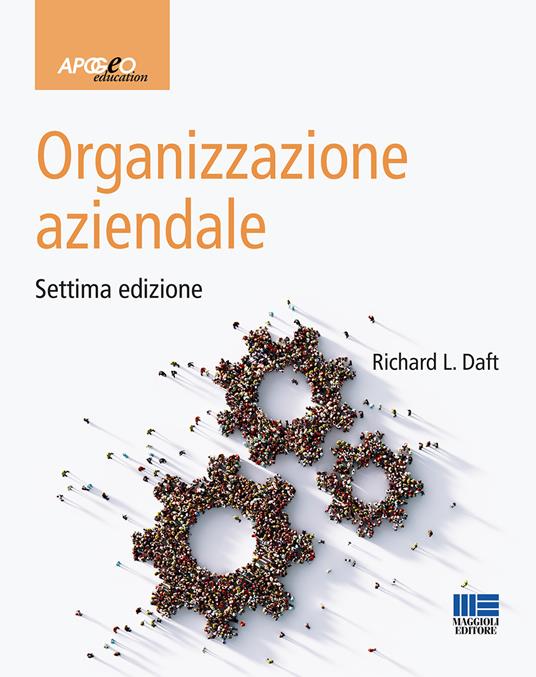
Organization Theory & Design
The world’s leading reference text for understanding how organisations are designed, structured and made to evolve. Daft analyses the relationship between strategy, external environment and internal structure, showing how organisational choices determine | far more than most believe | business performance. A rigorous book, grounded in empirical research and real cases, adopted at leading international business schools and essential reading for anyone who manages people and processes.
The key themes of organisational structure
Structure, system and environment
Daft defines the organisation as an open social system that interacts with its external environment. Structure is not an org chart | it is the set of formal and informal mechanisms that coordinate people towards common goals. Understanding this distinction is the first step towards effective intervention.
Structure follows strategy
One of the book’s central arguments: organisational structure must be consistent with business strategy. Organisations pursuing efficiency need different structures from those focused on innovation. Ignoring this alignment is one of the most common causes of organisational stagnation.
How many forms can an organisation take
Daft classifies organisational structures | functional, divisional, matrix, network | and explains in which contexts each works best. There is no universally superior structure: there is the right one for the company’s stage of development, size and target market.
Who does what, and why it must be clear
Role ambiguity is one of the main sources of inefficiency, conflict and turnover. Daft shows how role clarity | defining tasks, authority and decision boundaries | is not a bureaucratic luxury but a necessary condition for individual and team performance.
Measuring without stifling
How do you measure performance in a way that is useful rather than stifling? Daft distinguishes between bureaucratic control, management by objectives and cultural control | explaining when to use each and how to combine them. A well-designed measurement system holds people accountable without demotivating them.
The organisations that survive are those that adapt
Organisational structures are not immutable: they must evolve with the business. Daft analyses the mechanisms of organisational change | resistance, levers of intervention, sequencing of actions | and how to manage transitions without losing key people along the way.
Performance management, leadership and work-related stress: key answers
Want an organisation that
runs without you?
Let’s analyse your company’s structure together and define roles, responsibilities and supervision systems that hold up even in your absence.
Book a call
rispondo personalmente
I recommend Daft to every business owner who feels like the sole point of reference in their company. Not because you need an org chart | but because you need to understand that structure is a tool for real delegation, not bureaucratic formality.
In my work with businesses, the starting point is always the same: map how the organisation actually works, not how it looks on paper. From there, roles are redesigned, responsibilities defined, and a performance supervision system built that does not require the owner’s constant presence to keep everything running.