
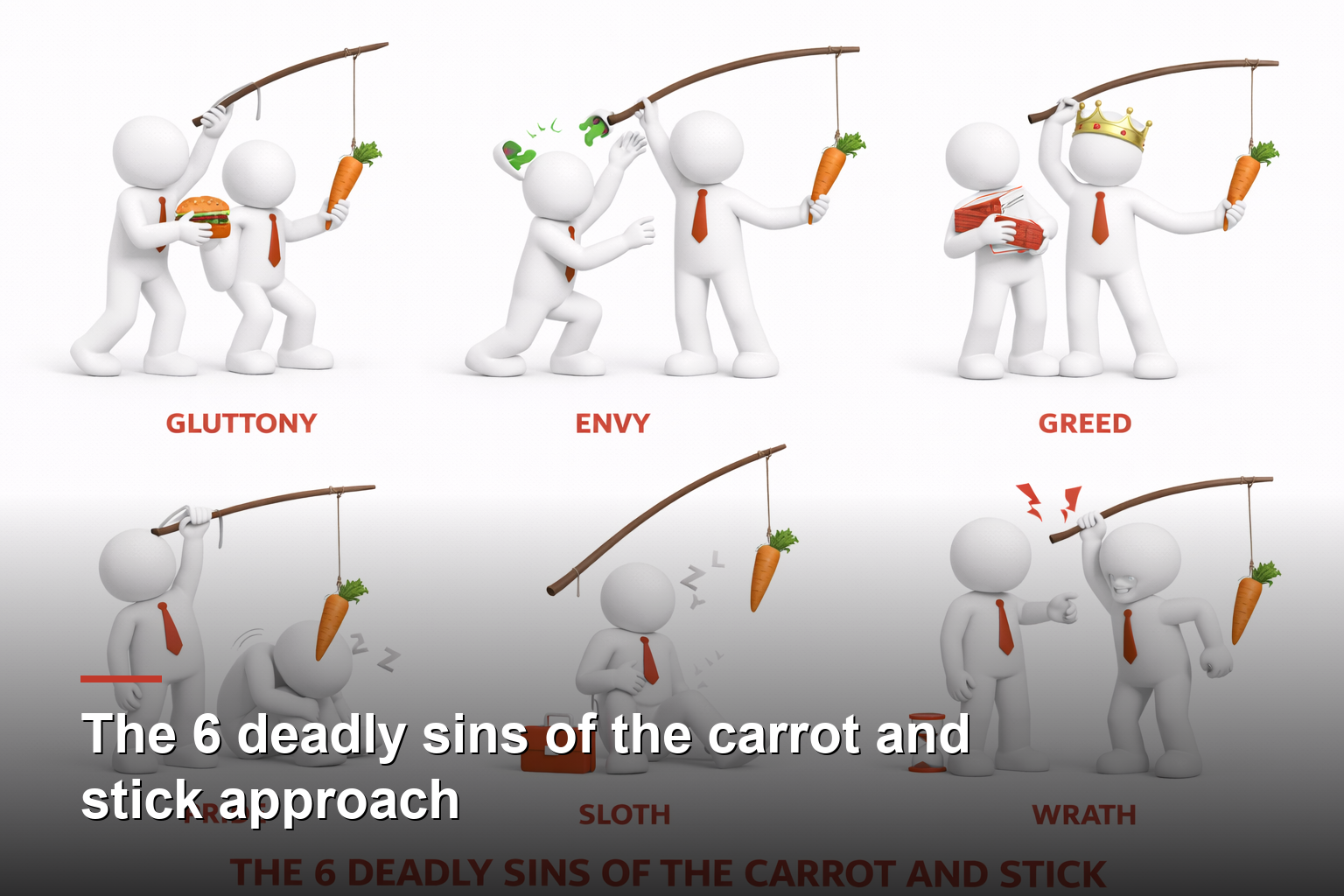
The 6 deadly sins of the carrot and stick approach, in summary:
These are Daniel H. Pink’s deadly sins, which show us why it is inadvisable and entirely pointless to adopt ‘If… Then…’ type rewards:
1) They can reduce performance
2) They can stifle creativity
3) They can stifle good deeds
4) They can encourage cheating, shortcuts and misconduct
5) They can create dependency
6) They can encourage short-term thinking
'If… Then…' type rewards are common tools in managerial practice. Many reward systems continue to be based on this conditional framework, even though the literature highlights structural limitations. Daniel H. Pink summarises these limitations in a series of flaws that explain why such rewards prove ineffective in people management. Organisational evidence shows that these levers do not support performance, motivation and learning. Strategic human resource management requires systems that value autonomy, competence and meaning, avoiding models that oversimplify the complexity of human behaviour.
The first flaw concerns reduced performance. Conditional rewards focus attention on an external goal and distract from the quality of the task. Research on incentive systems shows that when attention shifts to the incentive, cognitive depth is reduced and performance declines, particularly in non-standardised activities. This effect is evident in roles that require analysis, decision-making and the management of complexity.
The second flaw concerns creativity. Studies on intrinsic motivation show that conditional rewards narrow the cognitive field, reduce the ability to generate alternatives and limit divergent thinking. Pink links this dynamic to a perceptual compression that hinders innovative solutions. HR systems geared towards professional development require contexts that encourage exploration, not structural constraints.
The third pitfall concerns the stifling of prosocial actions. When behaviour stems from internal motivation, adding an external reward can reduce the perceived value of the act. Psychological contract theory demonstrates how motivation is based on implicit exchanges of trust and recognition. The introduction of conditional rewards alters this balance and reduces the spontaneous willingness to collaborate.
The fourth flaw concerns misconduct. The incentive effect can lead to deviations, shortcuts or attempts to manipulate evaluation criteria. The literature on reward systems highlights this risk. Schemes such as profit-sharing or individual bonuses, if poorly designed, can encourage opportunistic behaviour and reduce the quality of interaction between colleagues. The system becomes fragile. The organisation suffers the consequences.
The fifth flaw concerns dependency. People begin to respond only to external stimuli. Intrinsic motivation weakens. Professional behaviour becomes reactive and unregulated. Organisational psychology highlights how dependence on conditional rewards transforms the HR system into a costly and progressively ineffective mechanism. The organisation must increase the incentive leverage to maintain the same level of response. The cycle becomes unsustainable.
An analysis of the deadly sins described by Pink calls for a rethink of reward systems. Companies that focus on quality, learning and responsibility build models based on autonomy, clear objectives and continuous feedback. Studies on organisational well-being show that systems which support intrinsic motivation improve the working atmosphere, cooperation and the stability of performance over time. HR management must therefore reduce reliance on conditional incentives and prioritise schemes that reinforce competence and meaning.
As Pink states, ‘people do not perform at their best when they are pushed. They do so when they feel free to commit themselves’. HR management has the task of creating environments that make this freedom possible.
ESSENTIAL READING LIST
Pink D.H., Drive. The Surprising Truth About What Motivates Us.
Avallone F., Bonaretti M., Organisational Well-being.
Kaiser S., Ringlstetter M.J., Strategic Management of Professional Service Firms.
OD&M Consulting, Reward Systems. A Guide to Design.
University Handbook of Human Resource Strategy.
WEBGRAFIA
INAIL, Work-related stress (2017) .
Springer, Professional Service Firms Management .