
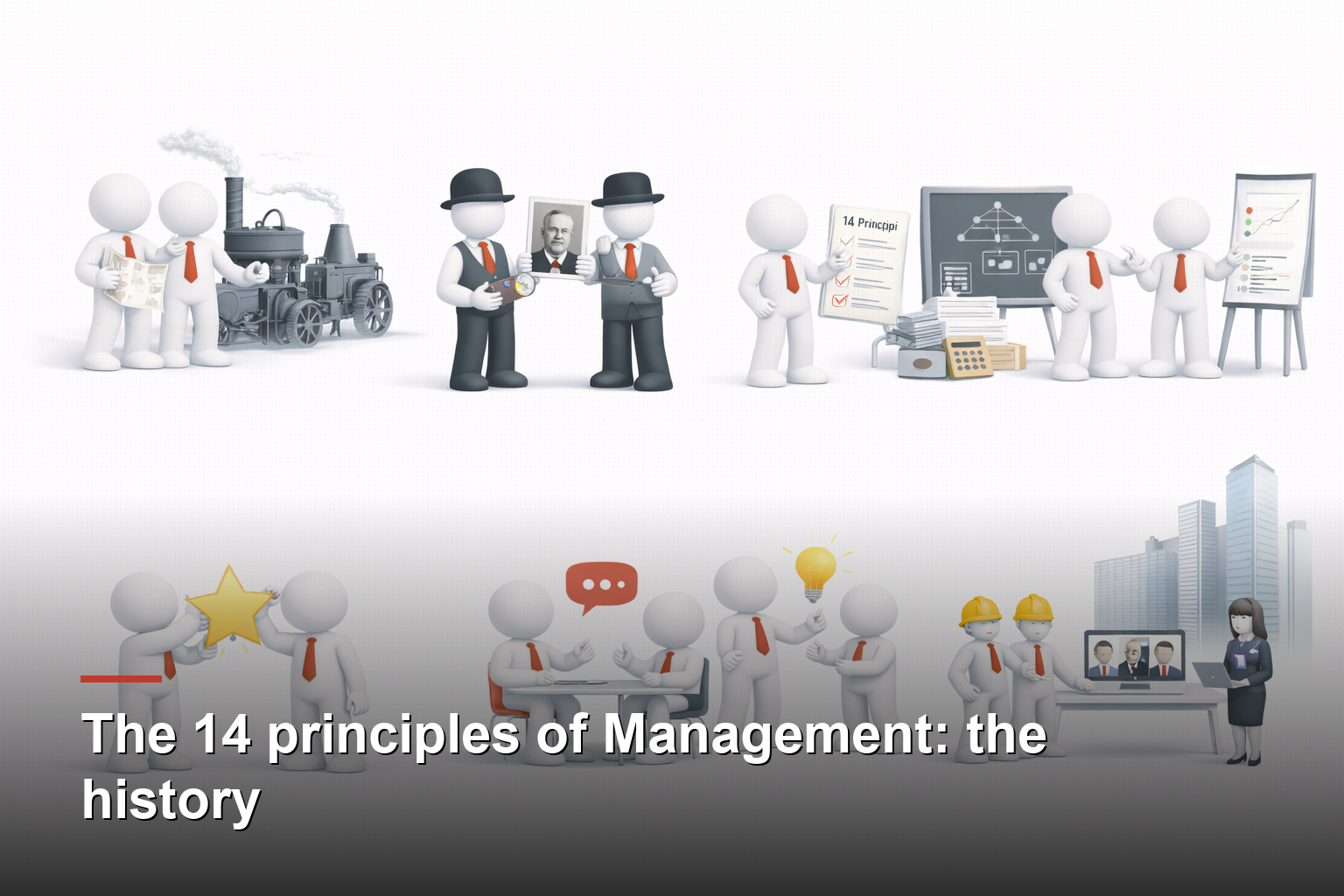
THE HISTORY
Henri Fayol (1841-1925) was a French management theorist and his theories of management and work organization were widely influential in the early twentieth century. He was a mining engineer working for a mining company, French Commentry-Fourchamboult-Decazeville, initially as an engineer. He later moved into general management and became Chief Executive Officer from 1888 to 1918. During his tenure as Chief Executive Officer he wrote various articles on “administration” and in 1916 the Bollettino de la Société de l’ Industrie Minérale, printed his “Administration, Industrielle et Générale – Prévoyance, Organisation, Commandement, Coordination, Contrôle”. In 1949 the first translation into English appeared: “General and Industrial Management” by Constance Storrs.
THE 14 PRINCIPLES
- Division of Labor. Specialization allows the individual to develop experience and continually improve his skills. So it can be more productive.
- Authority. The right to give orders, with which must go the balanced responsibility of his function.
- Discipline. Employees must obey, but this has two sides: Employees will obey orders only if management does its part in providing good leadership.
- Unity of Order. Each worker should have only one leader with no other conflicting lines of order.
- Unity of Management. People engaged in the same kind of activity must have the same goals in a single program. This is essential to ensure unity and coordination in the enterprise. The unity of order does not exist without unity of direction but does not necessarily depend on it.
- Subordination of individual interest(to the general interest). Management must understand that companies’ objectives are always paramount.
- Salary. Payment is an important motivator although, analyzing a number of possibilities, Fayol points out that there is nothing like a perfect system.
- Centralization(or Decentralization). The rank depends on the state of the business and the quality of its staff.
- Scalar chain(Line of Authority). A hierarchy for management units is necessary. But lateral communication is also critical, as long as superiors know that such communication is happening. The scalar chain refers to the number of levels of the hierarchy from the last authority to the lowest level of the organization. It should not be ultra elastic and consist of too many layers.
- Order. Both the material order and the social order are necessary. The former minimizes wasted time and unnecessary handling of materials. The second is achieved with organization and selection.
- Equity. In conducting business, “a combination of kindness and justice” is necessary. Treating employees well is important to achieving fairness.
- Staff Stability. Employees work better if they are assured of job security and career development. Insecure employment and a high employee turnover rate will negatively affect the organization.
- Initiative. Allow all staff to show that their initiative is in some way a source of strength for the organization. Even if it involves sacrificing the “personal vanity” of many managers.
- Esprit de Corps. Management must support the morale of its employees. Furthermore, he suggests that: “true talent is necessary to coordinate effort, encourage perspicacity, use each person’s abilities and reward each person’s merit without arousing possible jealousy and disturbing harmonious relationships.