
. is .
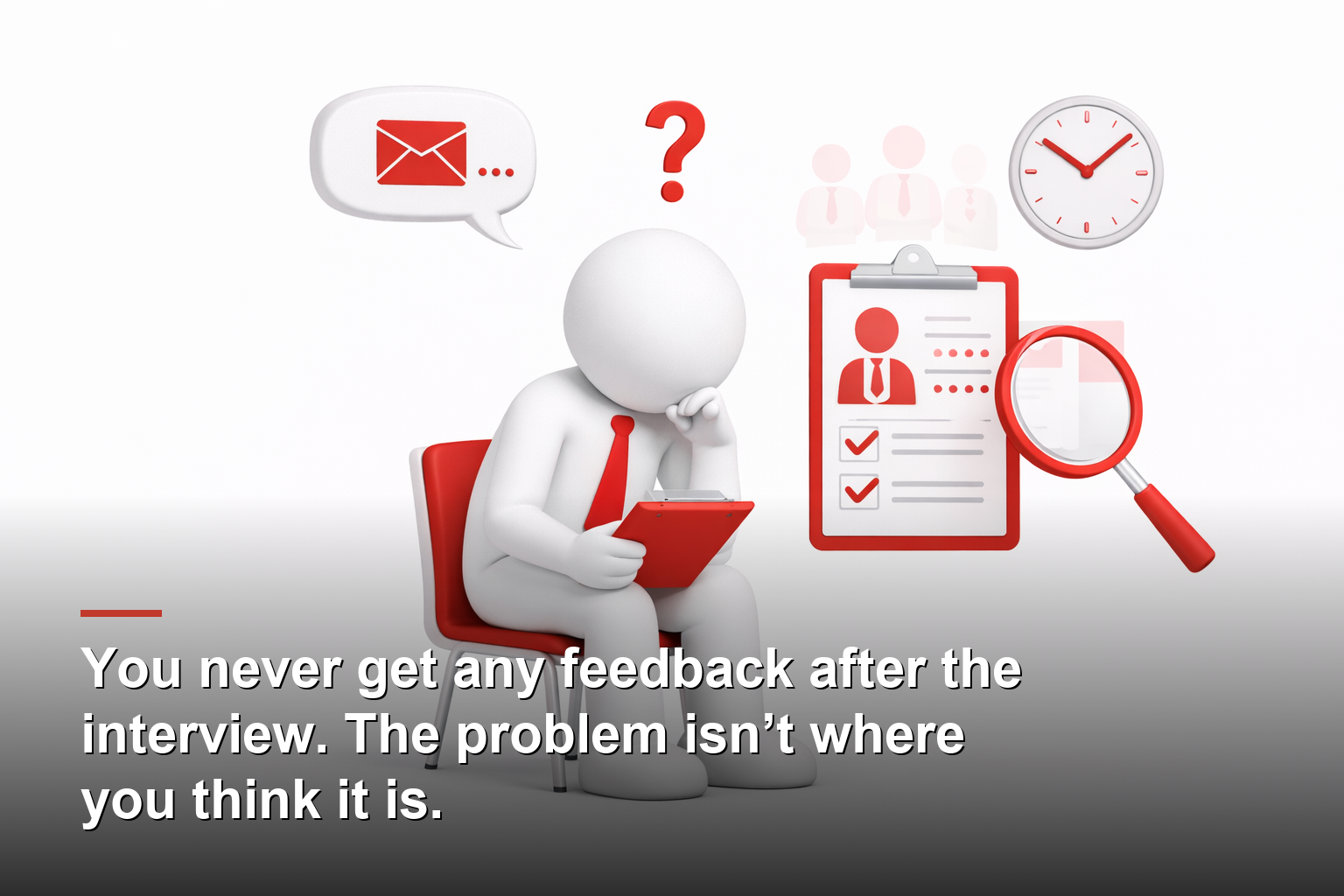
You wait. Days, sometimes weeks.
Then you convince yourself that perhaps you said something wrong, that perhaps your CV wasn’t good enough, that perhaps you weren’t convincing enough in your last answer.
Wrong.
The silence you receive after an interview rarely depends on what you did or said in that room.
It depends on how the process works on the other side.
And understanding that changes everything.
The job interview is not a symmetrical conversation
Many candidates arrive at the interview convinced that it is an equal meeting: you introduce yourself, they assess you, and at the end of the process they communicate the outcome.
Reasonable. But that is not how it works in most organisations.
The job interview is a tool for the company, designed to gather predictive information about the candidate’s future behaviour (Zerilli, 1994; Gandolfi, 2003).
Communicating the outcome is not an integral part of the process. It is, in most cases, a discretionary courtesy.
And courtesies, under operational pressure, are the first to go.
‘
A typical recruitment process involves several stages: CV screening, initial interview, possible assessment centre, technical interview with the line manager, comparative assessment of candidates, final decision (Boldizzoni, 2002; Human Resource Management, Bruni et al.).
Each stage introduces variables.
The line manager has changed priorities. The position has been put on hold. An internal candidate has come forward. The budget has been renegotiated. The process has been delayed for organisational reasons that have nothing to do with you.
Meanwhile, on the other side, you wait. And you interpret the silence as a judgement.
It isn’t.
Silence is, almost always, a sign of disorganisation or operational overload, not an assessment of you as a person.
The real problem: you’re reading the wrong signal
When a candidate receives no feedback, the automatic response is to look for the fault in themselves.
This is a specific cognitive distortion: confirmation bias applied to self-assessment. You seek confirmation of your own inadequacy in a given fact — the silence — which does not contain it.
The result is doubly damaging:
▪ You go into the next interview burdened by insecurity built on non-existent evidence.
▪ You alter your presentation in response to feedback that never arrived.
But there is a second, more subtle level to the problem.
It reveals a great deal about the quality of that organisation’s selection process.
And this is useful information. If you know how to read it.
What an organisation’s silence really says
A recruitment process is, among other things, the first real point of contact a candidate has with the corporate culture.
How a company manages its communications with candidates — including those who are not selected — is an indicator of the quality of its internal processes and the respect with which it treats people.
HR literature on the candidate experience is consistent on this point: a negative perception of the selection process translates into measurable reputational damage to the employer brand, especially in labour markets where candidates are also potential customers or referrals (Aguinis, 2013).
To put it bluntly: a company that cannot find the time to communicate the outcome of an interview probably applies the same standards to managing its own staff.
This is not a condemnation. It is a fact to be considered.
. .
You cannot control whether a company will give you feedback.
You can control whether you turn that silence into useful information or a self-defeating narrative.
Here are three concrete cognitive and practical steps:
▪ Ask in advance. Before the interview ends, ask what the expected timeline for the process is and how the outcome will be communicated. It’s not pressure. It’s managing expectations. Anyone who can’t answer probably doesn’t have a structured process.
▪ Set an internal deadline. If you haven’t heard anything by the date given, send a brief and to-the-point follow-up message. Just one follow-up. Then treat the silence as an answer and move on.
▪ Don’t change your approach based on silence. If you don’t know what went wrong, you can’t fix it. And often there’s nothing to fix.
A note for those involved in recruitment
If you are reading this article in an HR or managerial role, the message is simple.
The cost of silence is not zero.
Every candidate who leaves a process without feedback is a contact who has had a negative experience with your organisation. In markets where reputation and word of mouth matter, this has real economic value, even if it is never measured.
Establishing a minimal, standardised communication process for unsuccessful candidates is not a matter of courtesy. It is a decision regarding the governance of HR processes.
In summary
Silence after an interview is not a judgement.
It is, in almost all cases, the result of unstructured processes, operational overload and organisational priorities that have nothing to do with you.
Stopping interpreting it as a message about your suitability is the first step towards managing a job search methodically rather than anxiously.
And in the job market, method makes all the difference.
If this is the first time you’ve read one of my posts: I’m Alberto and I work with candidates in career transition on career repositioning, personal branding and active job search strategies.
I use LinkedIn to connect with people who are tackling this journey with a clear head and determination.
If you’re in this phase too, get in touch.
Bibliographical references
Zerilli A. (1994), Recruitment, Selection and Induction of Staff, Franco Angeli, Milan.
Gandolfi G. (2003), The Selection Process: Tools and Techniques, Franco Angeli, Milan.
Boldizzoni D. (ed., 2002), Human Resource Management, Il Sole 24 Ore, Milan.
Aguinis H. (2013), Performance Management, 3rd ed., Pearson, Upper Saddle River.
Bruni A., Gherardi S. (2007), Studying Work Practices, Il Mulino, Bologna.