
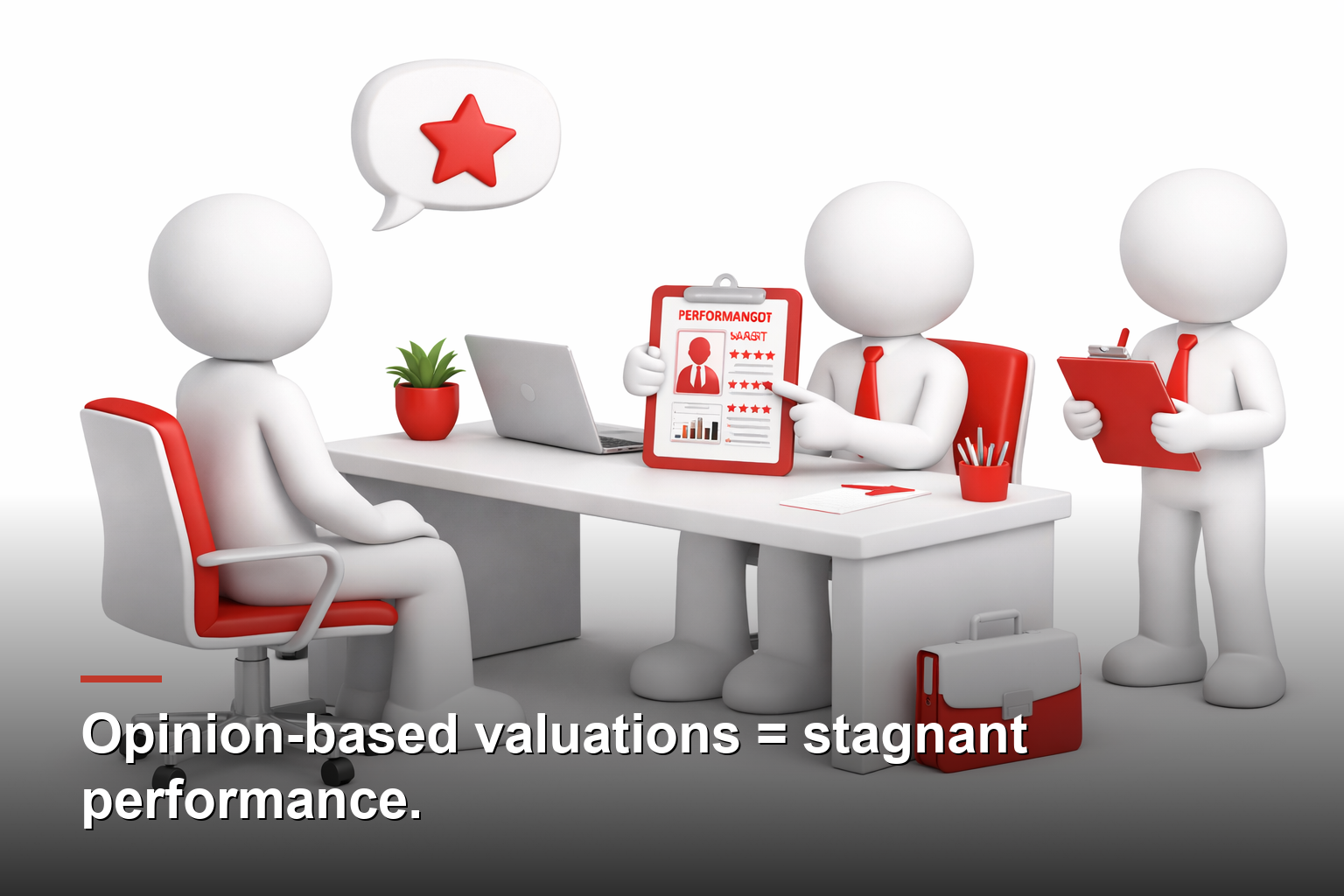
In companies, performance appraisal risks remaining a mere organisational formality. A meeting at the end of the year where the manager assigns a rating and the employee nods in agreement most of the time. There is no development in this exchange. The key point is clear. A rating is an opinion. An opinion does not guide performance. An opinion does not foster accountability. An opinion does not support a consistent decision-making process.
- Ratings do not follow common criteria and vary from manager to manager.
- Reward systems lose alignment with results.
- Conflicts remain hidden for months and undermine trust.
This happens because the system does not measure. It interprets. Appraisal remains an exercise in perception, not a tool for managing the organisation.
An effective performance system does not evaluate people. It measures results, standards and expected behaviours. Measurement creates order. It reduces arbitrariness. It makes leadership clearer. When we stop relying on ‘I think that’ and introduce clear, shared and verifiable KPIs, the way we work changes. People understand the direction. Managers communicate consistently. The company gains a solid basis for rewarding, developing and correcting.
In practice, measurement boosts motivation because it sets clear expectations. It improves productivity because it helps eliminate waste. It fosters accountability because everyone sees the link between actions and results. Assessment becomes a daily tool, not an annual event. The performance review becomes a journey. Mistakes cease to be a problem. They become data to be analysed.
Theoretical evidence confirms this logic. The measurement models described in the scientific literature show that performance improves when the system incorporates clear objectives, measurable standards and a direct link to variable pay. Appraisal works when it guides the relationship between the individual and their role and when it enables the organisation to make decisions quickly and in a coordinated manner.
The most robust companies share a common trait: they do not leave performance to perception but transform it into a structured process that generates value.
The employee is the protagonist of their own professional development.
A choice that requires method, clarity and discipline. A choice that enables the creation of a fairer and more productive working environment. Performance does not arise from judgement. It arises from measurement.
If you’d like a free preliminary assessment of your performance system, please get in touch via the ‘contact’ page
References
Avallone F., Bonaretti M. (2003). Organisational Well-being. Improving the quality of work in public administrations. Rubbettino Editore.
De Carlo N., Falco A., et al. (2017). The methodology for the assessment and management of work-related stress risk. INAIL – Department of Occupational Medicine.
Kaiser S., Ringlstetter M. (2011). Strategic management of professional services firms. Theory and practice. Springer.
Liker J.K., Meier D. (2007). Toyota Talent. Developing Your People the Toyota Way. McGraw-Hill.
OD&M Consulting (n.d.). Reward systems. A guide to design. OD&M.
Womack J.P., Jones D.T., Roos D. (1990). The Machine That Changed the World. MIT – Rawson Associates.
Yamashina H. (2005). World Class Manufacturing. FCA Case Study and Operational Implementations.
Various Authors (2008). Strategy, Human Resources and Value. University Handbook of Human Resource Management.
Chapters 11 and 12: Managing Performance and Evaluating Human Resources.
Formez PA (1999). Project Cycle Management. Training Manual. Presidency of the Council of Ministers.
Various Authors (2020). The New Organisational Manual. Methods for Job Descriptions, Responsibilities and Corporate Governance Systems.