
1. Introduction
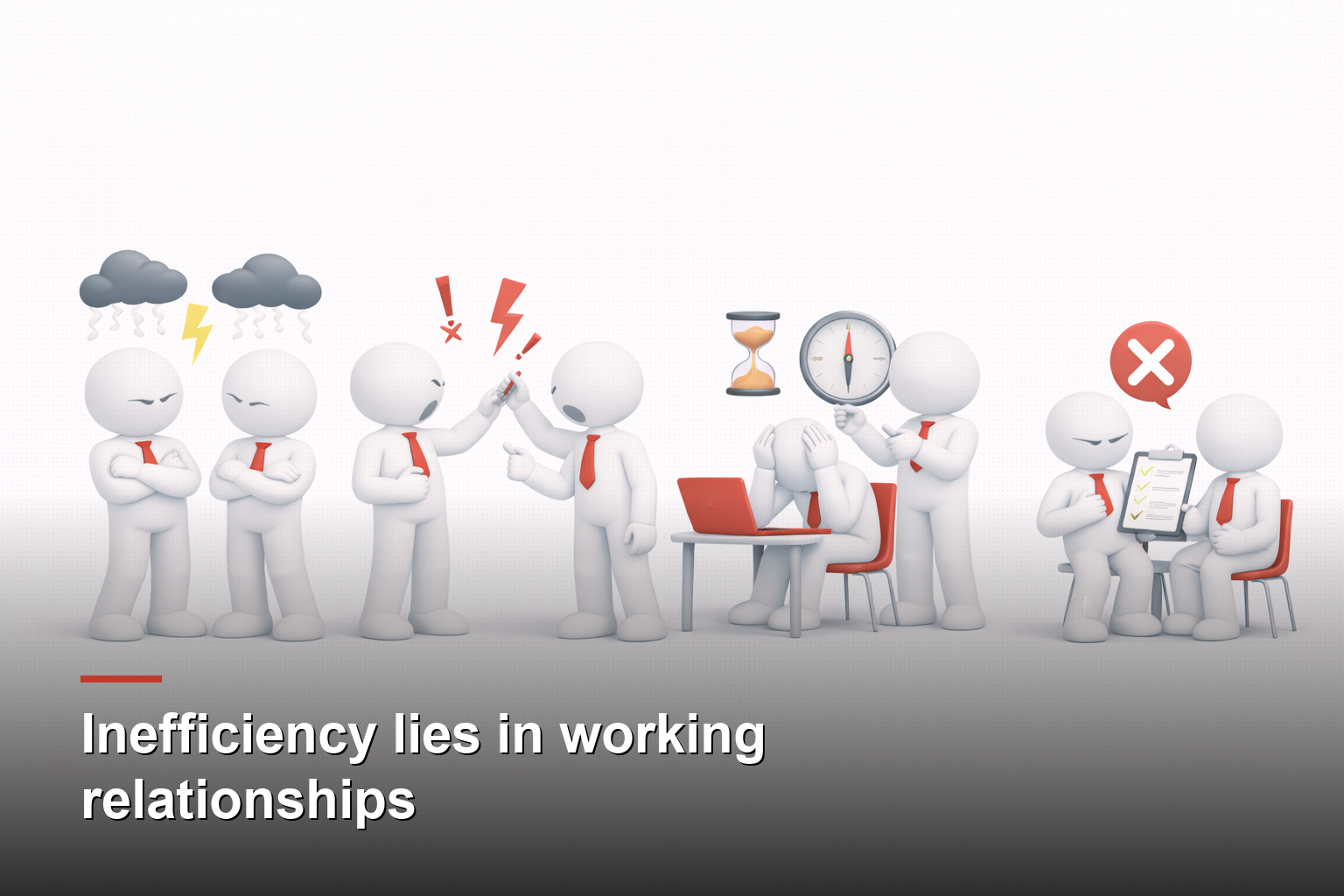
Corporate productivity is often interpreted as the result of more or less advanced technical skills, operational tools or organizational models. However, a significant part of the scientific literature indicates that the main source of inefficiency in organizations lies in work relationships. Professional relationships, the quality of leadership and the internal climate generate direct impacts on turnover, engagement and individual and collective performance.
SMEs, due to their informal structure and the concentration of decisions in a small number of figures, are particularly exposed to the effects of unmanaged relational conflicts. The evidence reported confirms the centrality of the human factor as a critical lever of organizational functioning.
2. Evidence on the relational nature of inefficiency
2.1 Conflicts, complaints and hidden costs
According to the Chartered Institute of Personnel and Development (CIPD, 2017), an employee spends on average 12 days a year complaining about processes, colleagues or management. This time, often invisible in economic accounts, erodes productivity and fuels a negative organizational climate.
In parallel, employers dedicate over 13 days a year to the management of internal conflicts. The opportunity cost of this commitment affects the company’s ability to dedicate time to strategic development and innovation.
2.2 Engagement and quality of relationships
Only the 30 percent of workers declares himself actively engaged (Gallup, 2023). The data is not just a cultural indicator, but a measure of the quality of professional relationships, the clarity of objectives and perceived support.
The Saratoga Institute highlights that the80 percent of resignations are caused by relationship problems, in particular conflicts with the direct superior. This evidence confirms the systemic impact of daily leadership on organizational well-being.
2.3 Waste of managerial time and lack of trust
Managers lose between 25 and 30 percent of the day to manage unproductive discussions, misinterpretations, personal conflicts and procedural misunderstandings. Trust in leaders is significantly low. Only the 30 percent of employees declares that he trusts his superior, a fact that directly affects commitment and collaboration.
In the end, two-thirds of workers feel undervalued, and when evaluated, believes that the process does not correctly represent their contribution.
These phenomena make up a clear picture: the loss of efficiency does not lie in skills, processes or the labor market, but in the fragility of the relational system and the leadership models adopted.
3. Theoretical interpretation: why do work relationships generate inefficiency?
Organizational relations theory (Schein, 2010) highlights that every business system functions on the basis of implicit norms, expectations and communication models. When these elements lack coherence or clarity, tensions emerge and manifest themselves in the form of:
-
interpersonal conflicts
-
decline in engagement
-
growing turnover
-
poor collaboration
-
operational inefficiency
The literature on Psychological Contract (Rousseau, 1995) confirms that the perception of fairness, recognition and support is a key determinant of performance. A violated psychological contract leads to defensive behaviors, demotivation and organizational abandonment.
4. The new approach required of businesses
If the main cause of inefficiency lies in working relationships, companies must adopt a model that does not limit itself to informing but transform behaviors, relationships and culture. The evidence suggests some priority levers.
4.1 Transform, don’t inform
Traditional training, oriented towards the transmission of content, has limited impact if it is not integrated with development programs, coaching, feedback and growth-oriented performance systems.
4.2 Promote self-management
Accountability (self-management) reduces conflicts, increases autonomy and allows workers to solve problems more quickly. Hackman and Oldham’s (1976) research on job design confirm that autonomy and meaningfulness of work improve performance and satisfaction.
4.3 Leave operational autonomy
Self-determination theory (Deci & Ryan, 2000) shows that people are more productive when they perceive autonomy and trust. Excess control generates resistance and defensive behaviors.
4.4 Orientation to the future
Developing concrete growth paths reduces turnover and fuels engagement. The learning organization model(Senge, 1990) highlights that the ability to continuously learn is a condition for competitiveness.
4.5 Build lasting collaborative relationships
Positive relationships reduce stress, increase the quality of work and improve the ability to deal with complex problems. The World Class Manufacturing and the Toyota Way (Liker & Meier, 2007) demonstrate that structured cooperation leads to superior performance and operational stability.
5. Conclusions
The data clearly shows that the main business inefficiency does not come from people, but from the way they interact. A weak relationship system generates high costs, slow decisions, turnover, conflicts and inefficiencies that no software or technical reorganization can compensate for.
Companies that invest in the quality of relationships, leadership, clarity of roles and the growth of people see a clear and stable improvement in performance.
To identify the areas in which an organization is losing efficiency, a targeted preliminary check can be useful, capable of quickly analyzing critical relational issues and management systems.
Bibliography
-
CIPD. (2017). Managing conflict at work. Chartered Institute of Personnel and Development.
-
Deci, E., & Ryan, R. (2000). Self-Determination Theory. Psychological Inquiry.
-
Gallup. (2023). State of the Global Workplace Report. Gallup Press.
-
Hackman, J. R., & Oldham, G. R. (1976). Motivation through the design of work. Organizational Behavior and Human Performance.
-
Liker, J. K., & Meier, D. (2007). Toyota Talent. McGraw-Hill.
-
Rousseau, D. (1995). Psychological Contracts in Organizations. Sage Publications.
-
Schein, E. H. (2010). Organizational Culture and Leadership. Jossey Bass.
-
Saratoga Institute. (2004). Employee Retention Survey. Saratoga Institute Research.
-
Senge, P. (1990). The Fifth Discipline. Doubleday.
Webography
-
CIPD – Conflict Management
https://www.cipd.co.uk -
Gallup – State of the Global Workplace
https://www.gallup.com/workplace -
SHRM – Workplace Conflict Research
https://www.shrm.org -
Harvard Business Review – Leadership & Organizational Behavior
https://hbr.org -
McKinsey – People & Organizational Performance
https://www.mckinsey.com -
MIT Sloan – Human Dynamics and Performance
https://sloanreview.mit.edu