
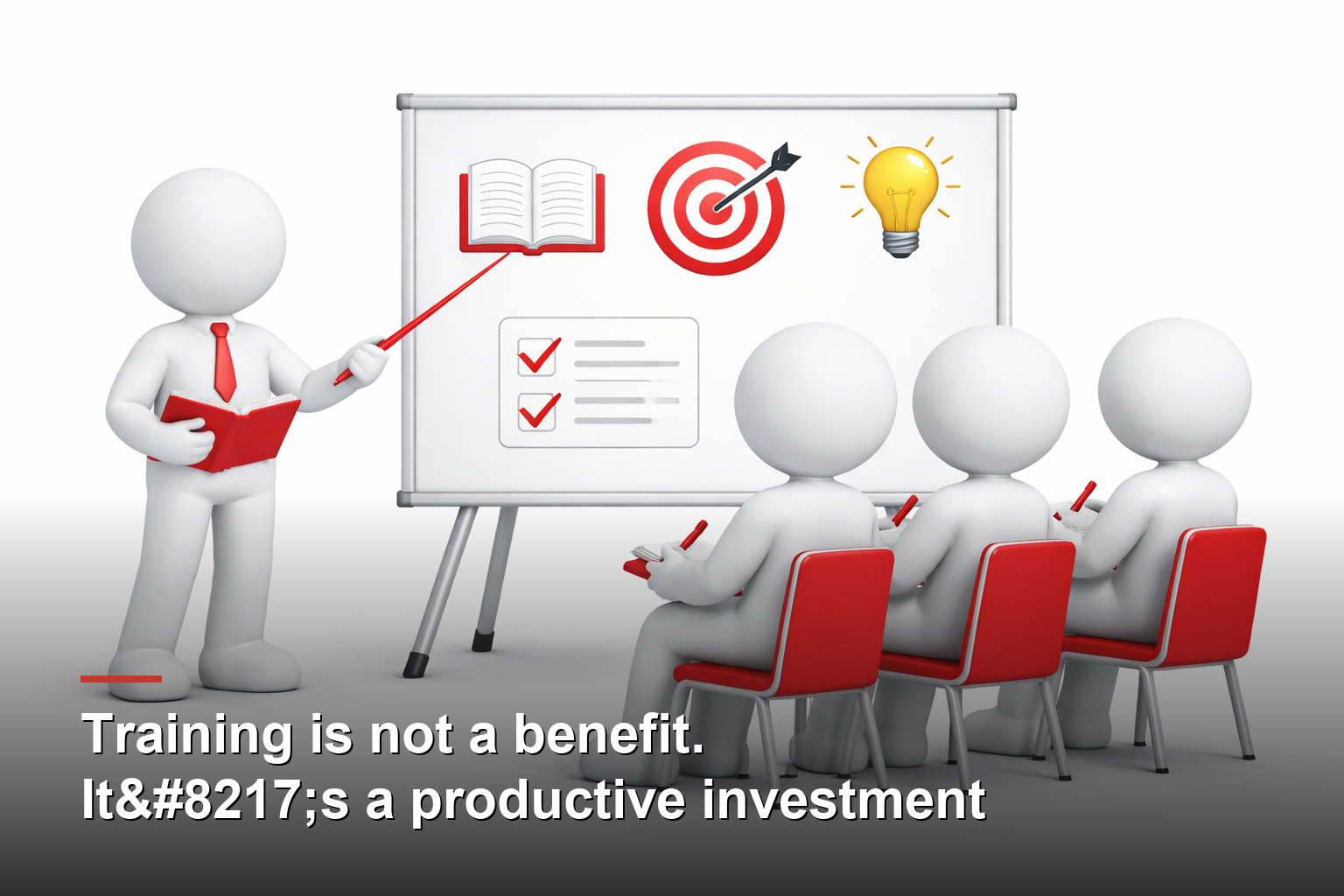
Training is not a “soft” cost, but a productive infrastructure that reduces errors, turnover and dependence on top management, increasing scalability and performance.
The real risk is not training people and losing them, but not training them and blocking the company’s competitiveness.
In the Italian managerial debate, training is still often placed in the area of discretionary costs. It is perceived as a “soft” element, useful for improving the climate, engagement or corporate image, but rarely as a structural lever of economic competitiveness. This approach is conceptually incorrect and strategically dangerous.
The history of production systems demonstrates the opposite. In the volume The Machine That Changed the World they comparatively analyze global industrial models and show how the best performing systems systematically invest in people’s skills. Not episodically, not as a function of public incentives, not as an emergency response to a problem, but as a permanent architecture of the operating model.
Lean production does not arise from control. It arises from the widespread ability to improve the process. And the ability to improve the process is a skill, not a casual intuition.
If training were only an individual advantage, Toyota would not have built a global competitive system based on continuous improvement. “World class” companies would not have integrated learning into their core processes. They would not have made distributed problem solving, intelligent standardization, incremental improvement structural.
Training, therefore, is not a reward. It is a productive infrastructure.
1. Training as a productivity lever, not as an additional cost
To understand the strategic role of training it is necessary to shift the focus from the individual to the systemic dimension.
When a company invests in skills it is not simply improving the CV of its people. The system’s capacity to:
-
prevent errors,
-
reduce variability,
-
speed up decisions,
-
innovate processes,
-
standardize good practices,
-
reduce critical dependencies.
In other words, it is reducing organizational entropy.
Productivity is not just a function of machines, technology and financial capital. It is above all a function of coordination capacity and widespread competence. Without skills, technology does not generate advantage. Without skills, processes are not respected. Without skills, procedures become bureaucracy and not a lever of efficiency.
The Operational Excellence paradigm, which integrates TQM, Lean Production, Just in Time and continuous improvement systems, is based on a clear assumption: people must be able to understand, analyze and improve their work. There is no operational excellence without operational expertise.
2. The three invisible costs of lack of training
Companies that consider training a cost to be reduced underestimate three structural costs that do not immediately appear in the income statement, but which directly impact margins.
2.1 The cost of error
Procedures not understood generate rework, waste, delays and non-compliance. Every error produces a multiplicative effect: wasted time, organizational stress, interfunctional conflicts, loss of credibility towards the customer.
The error is not just a technical defect. It is a sign of systemic deficit.
In lean systems, errors are treated as learning opportunities. In unstructured systems, the error is handled as individual fault. The difference is substantial. In the first case, organizational knowledge is generated. In the second, fear and repetition of the error are generated.
Training does not eliminate the error. But it reduces the probability that it will turn into a structural loss.
2.2 The cost of turnover
The perception of professional growth is one of the main retention factors. Research on organizational well-being highlights how development, autonomy and a sense of progress are crucial for staying in the company.
Turnover is not just a replacement problem. It is a loss of competence, a loss of organizational memory, a waste of managerial time. Each exit involves:
-
search and selection cost,
-
onboarding cost,
-
loss of productivity in the transition period,
-
overload on colleagues,
-
potential loss of customers.
The real cost of a resignation frequently exceeds two or three gross annuities of the employee, considering indirect impacts. Yet many companies still do not correlate training and retention.
2.3 The cost of dependence on the owner
An organization without widespread skills remains centralized. Decisions are concentrated in a few hands. The founder or management becomes the bottleneck.
This generates three consequences:
-
decision-making slowdown,
-
cognitive overload of the vertex,
-
inability to climb.
A company that depends on the owner is not scalable. It cannot grow beyond the individual capacity of the founder. Training distributes expertise and therefore distributes controlled decision-making power.
In systemic terms, training is a tool of responsible decentralization.
3. The false dilemma: “What if I train them and then they leave?”
The most frequent question in SMEs is: “What if I invest in training and then the employee leaves?”
The correct question is: “What if I don’t form it and it stays?”
An out-of-date contributor:
-
slows down innovation,
-
generates inefficiency,
-
requires constant supervision,
-
increases management’s decision-making burden,
-
blocks organizational transformation.
The persistence of obsolete skills is more dangerous than the loss of trained talent. Because obsolescence spreads throughout the system.
Training is not a guarantee of permanence. But the absence of training is almost a guarantee of stagnation.
4. Training and reward systems: economic coherence
Training cannot be isolated from the system performance management. If skill development is not linked to objectives, is not measured and is not integrated into incentive systems, it effectively becomes a cost.
Regarding reward systems, it is highlighted that variable remuneration must be consistent with measurable objectives and with the real contribution to the creation of value. Skills development is an integral part of that architecture.
An incentive system that rewards short-term results but does not invest in skills creates a dangerous distortion: immediate output is maximized while sacrificing future sustainability.
Training must be:
-
linked to KPIs,
-
integrated into evaluation processes,
-
included in a development plan consistent with the strategy.
Only in this way does it become a competitive lever.
5. Training as a strategic infrastructure
From a strategic management perspective, training is a highly leveraged intangible resource.
Professional services firms, for example, base their competitive advantage on knowledge, reputation and human capital. The strategic management of skills is therefore central to the very survival of the organization.
In a context characterized by:
-
digitalization,
-
technological acceleration,
-
continuous regulatory change,
-
growing competitive pressure,
competence becomes a critical asset. Not investing in training is equivalent to not investing in plant maintenance.
The difference is that the deterioration of skills is less visible than the deterioration of a machine. But the effects are just as serious.
6. Measuring the ROI of training
The main limitation in training management is the failure to measure the economic return.
Measuring ROI doesn’t mean reducing training to an Excel sheet. It means connecting investment and result.
Examples of metrics:
-
error reduction,
-
cycle time reduction,
-
reduction of complaints,
-
increase in productivity,
-
reduction in turnover,
-
climate improvement,
-
increase in talent retention.
The ROI of training is not immediate. But it is measurable in the medium term through consistent indicators.
A company that only measures costs and does not measure benefits produces a partial analysis.
7. The responsibility of the Management
Many entrepreneurs say that training does not generate value. In most cases the problem is not training, but its design.
If training:
-
it is not linked to KPIs,
-
it is not designed in systemic logic,
-
is not consistent with the strategy,
-
is not followed by operational application,
it will not generate value.
The responsibility lies with governance.
Effective training requires:
-
Needs analysis.
-
Connection with strategic objectives.
-
Measuring results.
-
Integration into reward systems.
-
Monitoring over time.
Without architecture, training becomes an event. With architecture, it becomes leverage.
8. Training and organizational culture
Company culture is not a slogan. It is the set of behaviors accepted and replicated.
A learning-oriented culture:
-
tolerate error as an opportunity,
-
promotes structured feedback,
-
encourages continuous improvement,
-
enhances technical and managerial competence.
A control-oriented culture:
-
punishes the error,
-
centralizes decisions,
-
discourages autonomy,
-
blocks innovation.
Training is a tool for cultural transformation. Not because it automatically changes behaviors, but because it creates awareness and a common language.
Without a common language there is no effective coordination.
9. The link between training and scalability
Business scalability requires replicable systems.
Replicable systems require:
-
clear standards,
-
widespread skills,
-
competent middle leadership,
-
formalized processes.
Training is the mechanism through which the organizational model is transferred.
Without training, growth breeds chaos. With training, growth breeds structure.
10. Strategic conclusion
Training is not a benefit. It’s not welfare. It’s not a motivational gesture.
It’s a productive investment.
Companies that treat it as an additional cost reduce their competitive ability over time. Companies that integrate it into performance systems and operational processes build organizational resilience.
The final question is not whether training costs money.
The question is: how much does it cost not to do it?
Does your company measure the economic return on training or still consider it a “soft” cost?
#HRStrategy #Training #PerformanceManagement #LeanOrganization #Leadership #Turnover #PMI